
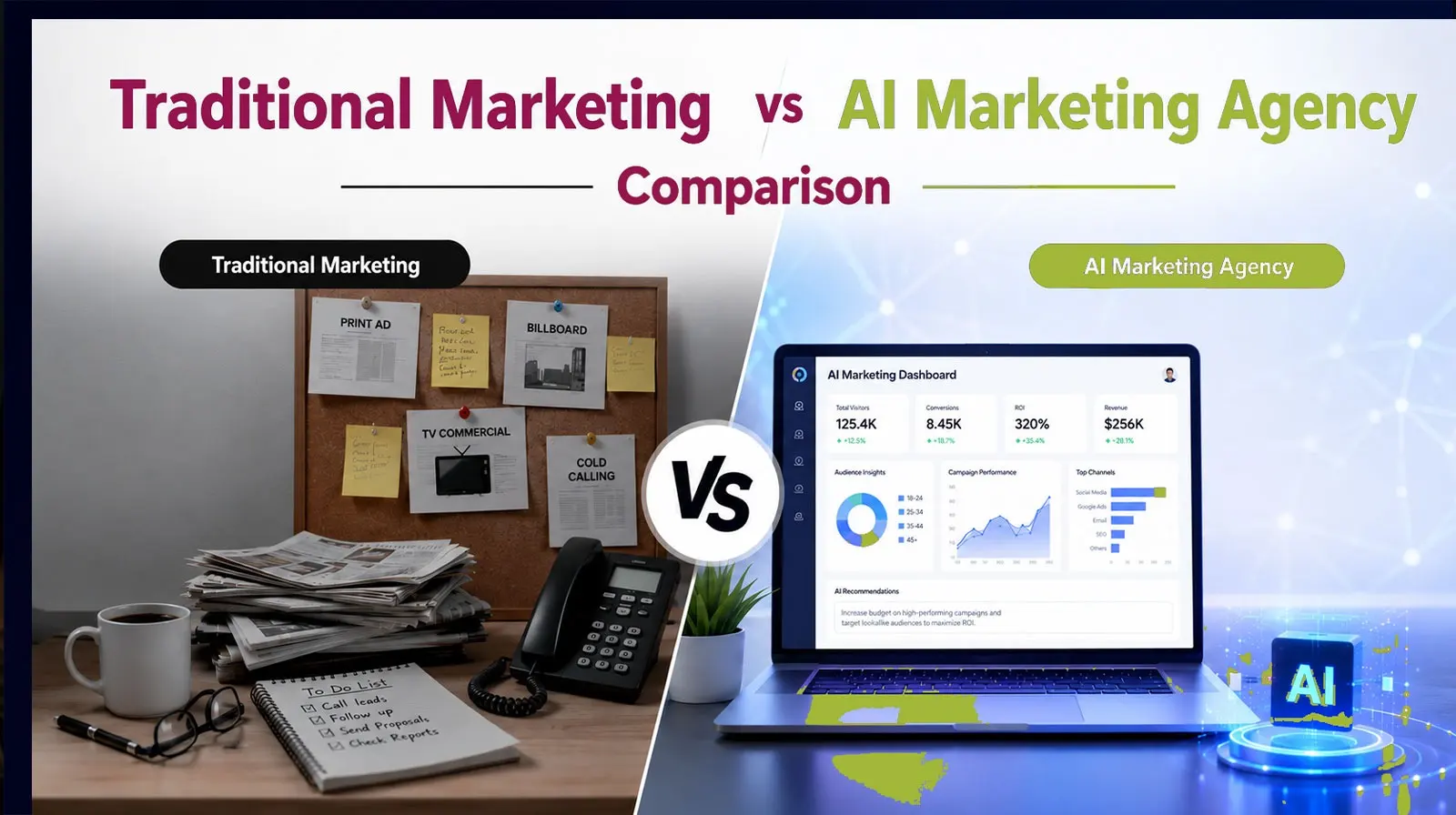
If you sit down with a marketing director today, you’ll likely hear a familiar complaint. They are exhausted by monthly agency review meetings. You know the drill: an account manager slides open a deck, spends forty minutes showing you beautiful graphs of “impressions” and “clicks,” and when you ask why your actual revenue didn’t budge, they tell you that “brand building takes time.”
That is the breaking point of the legacy model.
In 2026, the lines have been drawn clearly. On one side, you have traditional digital agencies doing manual media buying, writing content calendars three weeks in advance, and guessing target personas. On the other side, the rise of the AI Marketing Agency model has completely shifted the baseline of what a business should expect from its marketing spend.
The debate is no longer about whether automation works. The question is simple: Is your brand moving fast enough to survive an ecosystem that updates every single second?
IKF
The Core Difference: Reactive Strategy vs. Predictive Action
To understand why this shift matters, look at how data is treated by both setups.
A traditional digital agency is entirely reactive. They launch an ad campaign across meta platforms, let it run for two weeks, look at the aftermath, and then make manual adjustments. If a competitor suddenly dumps a massive budget into your exact keyword category on a Tuesday morning, a traditional team might not catch the efficiency drop until they run their weekly report on Friday. By then, thousands of your ad budget have already evaporated.
An AI Digital Marketing Agency handles this with predictive infrastructure. Instead of human analysts squinting at static spreadsheets, machine learning models monitor live data streams continuously. If user intent shifts or an ad format starts losing traction, the system adjusts bids, swaps visual creatives, and reallocates the budget in real time.
You aren’t paying people to sit around and manually pull levers anymore. You are paying for a live system that self-corrects before the mistake costs you money.
Hyper-Personalization: The Death of the Generic Persona
We’ve all seen those traditional marketing briefs that define a target customer as “Delhi-based working professionals aged 25-35 who love fitness.” That kind of broad categorization is incredibly lazy, and honestly, it doesn’t work anymore.
Humans are chaotic. A person’s buying behavior changes based on the weather, their current mood, the app they just closed, or the time of day.
While a classic team struggles to manually build three or four distinct audience variants, an AI Marketing Agency can segment an audience into thousands of individual micro-moments. The system looks at real-time behavioral signals like active search trails, instant sentiment on social platforms, and browsing depth. It then serves a dynamically tailored message exactly when that specific user is most likely to convert. It’s the difference between blasting a generic billboard message and having an individual conversation with every single prospect.
Where Does Human Creativity Actually Fit In?
When people hear about an AI Digital Marketing Agency, they often assume it means a cold room full of servers running automated code with zero human soul. That’s a total misunderstanding of the workflow.
The machine handles the heavy lifting, the media buying mathematics, the multi-variant testing, and the repetitive operational tasks. This actually frees up the human team to do what they do best: deep strategy, cultural positioning, emotional storytelling, and brand voice definition.
Instead of spending 80% of their week formatting spreadsheets and setting up manual ad sets, creative directors can actually focus on building a distinct, high-impact brand point of view. The tech doesn’t replace the marketer; it amplifies them.
Making the Choice
Sticking with a traditional setup because “that’s how we’ve always done it” is a comfortable path right up until your customer acquisition cost doubles overnight. The landscape in 2026 demands speed, hyper-relevance, and structural agility. If your agency is still relying on manual guesswork to protect your budget, it’s time to change the partner, change the playbook, and invest in a system built for the actual speed of modern business.
FAQs
- Will moving to an AI Marketing Agency mean my brand’s content sounds robotic?
It’s exactly the opposite. Low-tier agencies copy-paste raw text, which sounds robotic. A sophisticated AI Marketing Agency uses tools to analyze real human conversations, slang, and sentiment trends across forums and social spaces. This allows human copywriters to build frameworks that feel deeply authentic and highly localized, backed by data on what actually connects emotionally.
- Can small businesses benefit from an AI Digital Marketing Agency, or is it just for enterprise brands?
Small businesses actually stand to gain the most. Enterprise brands can afford to waste ad budget on broad, unoptimized testing. A small business with a tight budget cannot. Using an AI Marketing Agency setup ensures that every single rupee of your ad spend is micro-optimized in real-time, cutting out wasted reach and allowing smaller brands to compete directly with industry giants.
- How do these agencies handle data privacy regulations?
Any reputable AI Digital Marketing Agency builds its infrastructure around strict first-party data models and compliance frameworks. Instead of scraping sketchy third-party user data, the systems focus heavily on contextual behavior patterns and aggregated, anonymous performance signals. This keeps your brand completely safe from evolving privacy laws while maximizing conversion precision.